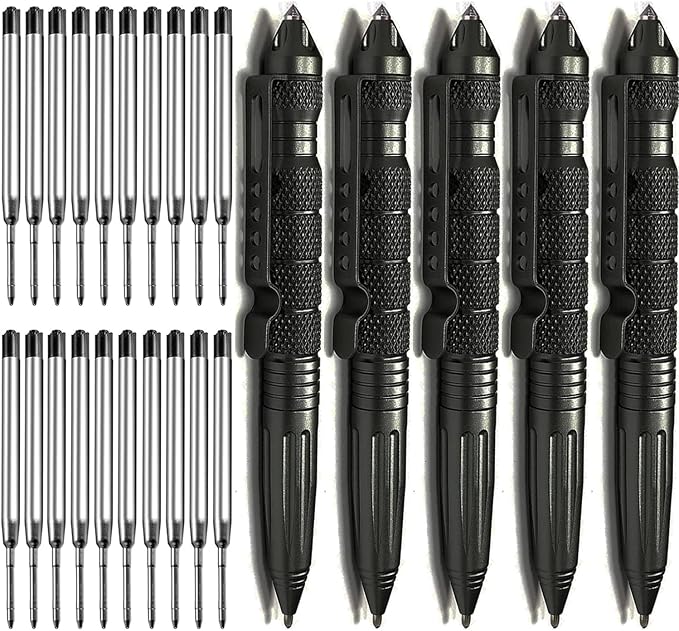
Origin-Joy 5 Pack Military Tactical Pens – Tungsten Steel EDC Self-Defense Pen Set with 20 Ballpoint Refills – Discreet Protection, Heavy-Duty Reliability, Everyday Carry Survival Tool


🟦 BULLET POINTS (FEATURES + THEMATIC EDGE)

Looks Like a Pen. Performs Like a Tool.
Crafted from ultra-durable tungsten steel, each pen is built to deliver discreet, dependable protection when you need it most.

MacGyver-Approved Multifunctionality
Write, defend, and break glass in emergencies — these pens do more with less, just like the icons of the ’80s and ’90s we grew up admiring.

Built for Real-World Readiness
Compact enough to carry daily, strong enough to count on in high-stakes moments. Quiet strength meets tactical confidence.

Smooth Writing. Serious Backup.
Includes 20 high-quality ink refills — so your EDC doesn’t stop working when the writing gets tough.

The ThinkPad of Tactical Gear
No flash, all function. Designed for professionals, first responders, and anyone who values reliability without the noise.


🟦 PRODUCT DESCRIPTION (NARRATIVE-DRIVEN + SEO SMART)

🔒 Stay Ready. Stay Under the Radar.

The Origin-Joy Tactical Pen Set is not just a writing tool — it’s a mindset. For those who know that real strength doesn’t shout, it just shows up when needed.

Inspired by the quiet resilience of Gen X heroes — from Jason Bourne’s calm precision to MacGyver’s everyday genius — this 5-pack of tungsten steel pens brings confidence and capability to your pocket.

Whether you’re commuting, traveling, or navigating uncertain environments, each pen offers:

  • Rugged tungsten steel build
  • Emergency glass breaker tip
  • Smooth ballpoint writing
  • 20 ink refills for long-term use
  • Subtle, professional design

Perfect for gifting, prepping, or everyday carry. Because in a world full of noise, strength is silent.


🟦 A+ CONTENT / ENHANCED BRAND CONTENT HEADLINES (if applicable):

  • Hidden Strength, Always Ready
  • Built for the Real World, Not Just the Boardroom
  • Inspired by Legends: Bourne. MacGyver. You.
  • 5 Pens. 20 Refills. 1 Mission: Be Prepared.

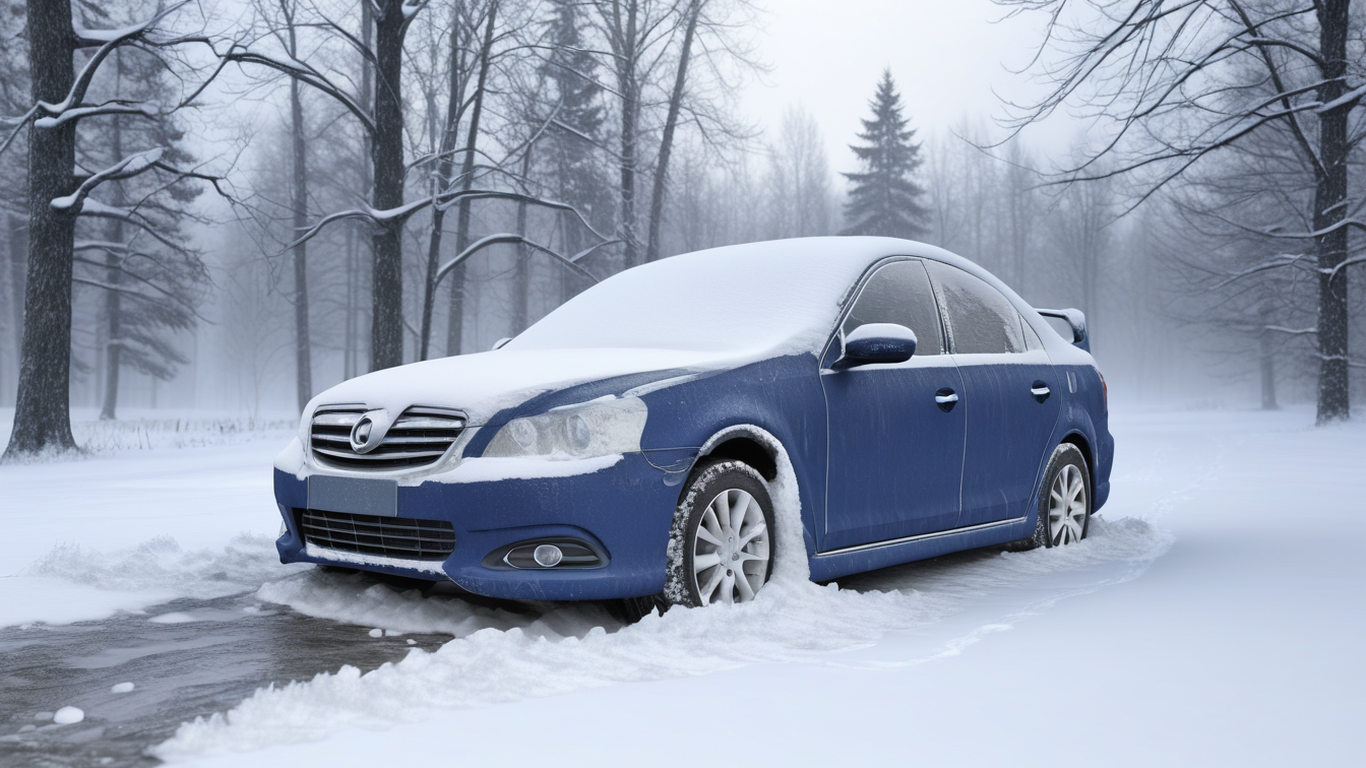
Early Winter Preps for Your Vehicle: A No-Nonsense, Slightly Rambling Guide to Not Freezing on the Side of the Road

You know that first cold morning of the season—the one where you sit in your car, turn the key, and nothing happens but a sad little click? Or maybe your windshield is frosted solid, and you’re scraping away with a loyalty card from the gas station because you forgot the ice scraper. Yeah. Winter sneaks up like that annoying neighbor who borrows your snowblower and never returns it.

But here’s the thing: it doesn’t have to. With just a little bit of prep work now—before the snow falls and your tires are basically skating on black ice—you can set yourself up for a winter that’s, well, survivable. Maybe even comfortable.

So grab a cup of coffee (or hot cocoa, if you’re fancy), and let’s go through everything you need to do to winter-proof your vehicle.


Why Winter Prepping Actually Matters (More Than You Think)

Look, cars hate the cold almost as much as you do. Fluids thicken, rubber stiffens, batteries quit, and roads turn into slip-n-slides. What’s worse, breakdowns don’t politely happen in your heated garage—they happen on the side of the highway in the middle of a snowstorm while your phone battery is at 3%.

The goal here isn’t perfection. It’s prevention. A little maintenance can save you from expensive repairs, dangerous situations, and, honestly, a whole lot of stress.


Step 1: Don’t Let Your Battery Ghost You

You know how your phone battery drains faster in the cold? Same thing with your car battery. Except you can’t just plug your car into the wall at Starbucks (well, unless it’s an EV, but that’s another rabbit hole).

  • Test your battery at a local shop. Many do it for free.
  • If it’s over 3 years old, replace it. Yes, even if “it’s still fine.” Winter doesn’t care.
  • Clean the corrosion off the terminals—it’s that green, crusty stuff that looks like your battery just aged 100 years.

And hey, toss a portable jump starter in the trunk. Trust me: the day you need it, you’ll thank past-you for being such a genius.


Step 2: Tires Aren’t Optional Ice Skates

Driving on bald tires in the snow? That’s like wearing flip-flops to a hockey game—you’re not going to win.

  • Check tread depth: Stick a penny in the grooves. If Lincoln’s head isn’t partly covered, you need new tires.
  • Pressure matters: Cold weather makes tire pressure drop, sometimes dangerously low. Check it monthly.
  • Consider winter tires: They’re not just marketing hype. The rubber is softer, so they grip better in the cold.

Think of tires as your shoes. Would you wear smooth-bottomed dress shoes to hike through snow? Nope. Same logic applies here.


Step 3: Fluids—Because Cars Get Thirsty Too

Your car is basically a coffee-drinking office worker—it needs the right fluids to function.

  • Coolant/Antifreeze: Make sure it’s a 50/50 mix, or else it might freeze solid.
  • Oil: In colder climates, your car might need thinner oil. Check the manual.
  • Windshield washer fluid: Regular stuff freezes. Buy the winter-grade blue stuff. (And keep an extra jug in the trunk, because salty slush is windshield paint.)

Step 4: Wipers, Visibility, and Not Driving Blindfolded

Imagine trying to watch Netflix with a screen smeared in peanut butter—that’s what bad wipers are like in a snowstorm.

  • Replace them before the snow starts falling.
  • Consider winter wipers. They’re sturdier and don’t freeze as easily.
  • Check your defrosters and heater. Don’t wait for the first storm to discover they’re busted.

Because honestly, if you can’t see, it doesn’t matter how good your tires are.


Step 5: Build an Emergency Kit (Future You Will Hug Present You)

Let’s be real: most of us think, “Eh, it won’t happen to me.” Until it does. Snow drifts don’t discriminate.

Here’s your starter kit:

  • Blanket, gloves, and hat (the kind you won’t mind ruining).
  • Ice scraper + snow brush. Not your credit card.
  • Flashlight (with fresh batteries).
  • Snacks. Seriously, keep a couple of granola bars in there.
  • A small shovel. Collapsible ones are cheap.
  • Kitty litter or sand for traction.

It’s not glamorous, but neither is sitting in your car for four hours waiting for a tow truck while your toes go numb.


Step 6: Fuel & Exhaust Checks

Quick tip: keep your gas tank at least half full all winter. Not only does it prevent fuel lines from freezing, but it also means you’ve got heat if you get stuck in traffic during a blizzard.

And before starting your car after a heavy snow, check the exhaust pipe. If it’s blocked by snow or ice, carbon monoxide can back up into the cabin. Silent, deadly, not worth the risk.


Step 7: Lights, Electronics, and “Seeing Is Living”

Shorter days = more driving in the dark.

  • Check every exterior light—headlights, brake lights, turn signals.
  • Carry spare bulbs. They’re small, cheap, and can prevent accidents.
  • Make sure you’ve got a working phone charger in the car. Because being stranded with a dead phone? Nightmare fuel.

Step 8: Protect the Exterior (Because Salt Is Basically Acid)

Winter isn’t just tough on engines—it eats at the body too.

  • Get a good coat of wax on before the snow hits. Think of it like chapstick for your car.
  • Wash regularly in winter. Yes, even when it’s freezing. Focus on the undercarriage.
  • Spray or rub silicone lubricant on door seals to stop them from freezing shut.

Nothing worse than yanking on your frozen door at 7 a.m. and realizing it’s glued shut by Mother Nature.


Step 9: The “Unexpected Happens” Plan

Winter doesn’t care about your schedule. So…

  • Tell someone your route before long drives.
  • Check weather reports.
  • Download roadside assistance apps (AAA, insurance-based apps, etc.).

Planning takes five minutes. Being stranded takes hours.


Bonus Section: Stuff People Forget Every. Single. Year.

  • Floor mats: Swap out the nice ones for rubber mats. Easier to clean and keeps your carpet from smelling like wet dog.
  • Spare tire: Check it! A flat spare is the definition of useless.
  • Gloves for gas pumping: Because grabbing that frozen nozzle with bare hands? Instant regret.
  • Sunglasses: Snow glare is real. Keep a pair in the car.

Winter Prepping by Vehicle Type (Because Not All Cars Are Created Equal)

  • SUV/Trucks: Great in snow, but don’t get cocky. They slide too. Keep the weight balanced—maybe throw a bag of sand in the bed.
  • Sedans: Lower clearance = easier to get stuck. Don’t try to plow through snowbanks.
  • Electric Vehicles: Cold zaps range. Plan for more frequent charging. Keep the charging port free of snow/ice.
  • Classics/Older Cars: They hate the cold. Store them if possible, or at least baby them with regular starts and fluid checks.

Wrapping It All Up: Winter Is Coming… For Your Car

At the end of the day, early winter prep isn’t about turning you into a mechanic. It’s about avoiding those “I should’ve listened” moments when your car lets you down in the worst possible conditions.

Yes, it takes a weekend. Yes, you’ll probably get a little cold while checking your tire pressure. But would you rather do it now, or at 6 a.m. on a January morning when your fingers are numb and your breath looks like smoke signals?

Take care of your vehicle, and it’ll take care of you. That’s the deal.

Adrenaline Forges the Map of Readiness: How Tactical Gear Rewires the Way You See the World

You don’t put on a tactical vest just to carry tools.
You put it on because the world changes the moment you strap in.

That simple act—buckling, tightening, adjusting—does something most people never realize: it alters the way your brain processes reality. The vest is not fabric. It’s not mesh. It’s a trigger. A signal to the nervous system that says: the game has shifted, and you’re already on alert.

And here’s the part that should stop you in your tracks—your body listens.


The Body Doesn’t Wait for the Threat

Most people believe readiness begins when danger shows its face. Wrong.
Readiness begins the moment your body believes the possibility is real.

Biologically, strapping in increases sympathetic tone. Norepinephrine floods out of the locus coeruleus, one of the brain’s primal alert centers. In plain English? Your body steps on the gas pedal before a threat even appears.

Heart rate calibrates. Breathing shifts into a shallower rhythm designed for quick bursts of energy. Muscles prime themselves for acceleration or resistance.

The tactical vest is not neutral—it’s a message. A physical code that unlocks your body’s combat software before the fight even starts.


Your Attention Map Gets Redrawn

Psychology tells us this shift is not subtle.
Once the vest is on, your attentional system recalibrates.

Instead of scanning the environment for comfort cues—the smile, the open space, the safe sound—your brain defaults to threat surveillance. The amygdala, your fear-processing hub, is no longer passive. It’s tuned to catch the flicker of movement in the periphery, the shadow that doesn’t match, the detail others dismiss.

Every object becomes potential. Every sound acquires weight. The world doesn’t blur—it sharpens. And once you experience that shift, going back to “normal” feels like leaving your guard down.

This is where readiness training becomes essential. Without it, vigilance becomes noise. With it, vigilance becomes clarity.


Readiness Is Not Just a State—It’s a Filter

Philosophically, the implications run deeper than gear or survival.
Wearing tactical readiness alters reality itself.

The world doesn’t appear as it is—it appears as your nervous system is tuned to perceive it. Strap on the vest and reality reshapes around vigilance. Take it off and the softness returns. Same world, different filter.

The gear is not simply protecting you from threats—it’s changing the lens through which you meet existence. What you notice. What you trust. What you prepare for.

And this raises the bigger question: if adrenaline readiness can rewrite reality so quickly, what other lenses are shaping what you believe is “real”?


The Psychology of Control in a Chaotic World

Why does this matter? Because chaos is constant. Whether you’re preparing for a literal threat or navigating daily uncertainty, your nervous system craves signals of control.

Survival gear provides one of the most powerful cues. It says: you are not passive, you are prepared.

That message ripples outward. It boosts confidence. It stabilizes breathing. It shifts posture into assertive readiness. The nervous system doesn’t just hear it—it believes it.

And when the nervous system believes, performance follows.


The Hidden Cost of Inaction

Here’s the trap most people fall into: waiting.

They think readiness is something you summon in the moment. But biology says otherwise. Without the embodied cue, the system lags. Reaction is slower. Attention is scattered. The amygdala is caught off guard instead of pre-loaded.

Every millisecond counts when threat is real. Those who practice preparedness mindset—who strap in not just for the weight but for the neurological advantage—move through the world with a baseline edge. Those who don’t? They gamble with delay.

And delay is the most expensive mistake you can make.


Gear as Identity, Not Accessory

It’s easy to see tactical gear as utility.
Pockets, holsters, belts. Storage and access.

But that misses the deeper truth. Gear is identity. It fuses with the nervous system’s definition of self. Wear it often enough, and your proprioceptive map—the brain’s sense of where your body begins and ends—expands to include it.

You don’t carry the vest. The vest carries you.
It becomes part of the self you project, the self you feel, the self you trust when the world tilts unstable.

This isn’t just about survival. It’s about ownership of reality.


The Practical Edge: Why This Matters Now

In today’s environment—uncertainty, volatility, disruption—readiness is not optional. It’s the new baseline.

Every decision you make, from career to crisis, is influenced by the state your nervous system is in. Calm systems see opportunities. Alert systems catch threats. Neutral systems get blindsided.

By understanding how tactical vests and survival gear rewire the body, you gain a tactical advantage most people never think about: control over your perception itself. That is the real battlefield. And those who control perception control outcome.


The Takeaway: Readiness Is a Choice

The act of strapping in is more than habit. It’s ritual. It’s neurobiology. It’s philosophy made flesh.

You can drift through life unprepared, letting your nervous system lag behind reality. Or you can engage the filter of readiness—gear, training, awareness—that keeps you two steps ahead.

Readiness is not waiting for the world to shift.
Readiness is shifting first.


Your Next Move

Don’t treat your tactical vest as an accessory. Treat it as the trigger that recalibrates your biology, psychology, and philosophy of self.

The cost of inaction is delay. The reward of readiness is control.

The question isn’t whether the world will test you—it’s whether you’ll be ready when it does.
And readiness, like the vest, is something you put on before the moment arrives.


Final Word: Adrenaline forges the map of readiness. But you decide if the map is drawn in advance—or scribbled in panic after the threat has already arrived.


SEO Tags

Stress Rewrites Reality Before Bullets Do

When societies fracture, it’s not the food lines that fail first—it’s the meaning lines.

We like to think collapse begins with empty shelves. But history and neuroscience point to something darker: our perception of reality itself becomes the first casualty. Before bodies fall, belief systems warp. Before bullets fly, the brain starts rewriting the script.

This isn’t abstract theory. It’s biology. And if you understand it, you can protect yourself from becoming trapped inside a false world when stress fractures the real one.


The Invisible War Inside Your Head

Stress is not just “feeling tense.” It is a full-scale neurochemical assault on how you interpret the world.

When the HPA axis floods your body with cortisol and the locus coeruleus surges noradrenaline, your brain’s filters shift. The thalamus—the gatekeeper of sensory input—stops letting everything through. Instead, it favors threat signals.

Your cortex, which usually updates predictions based on new evidence, begins to lean on old beliefs instead. Your hippocampus, desperate for safety, fills in gaps with familiar patterns.

Translation? Under stress, you stop seeing what is and start seeing what feels consistent with your fears.


Why False Stories Feel Safer Than True Ones

Here’s the paradox: the truth is often messy, incomplete, ambiguous. In stable times, your brain can handle that. In crisis, ambiguity feels like death.

So your nervous system cheats. It grabs a narrative—any narrative—that offers coherence. Even if it’s false.

This is why conspiracy theories bloom in unstable times. They’re not madness; they’re stress relief mechanisms. Believing “someone is behind it” feels safer than “no one is in control.”

Every new crisis becomes a magnet for tribal explanations. “They did this.” “It’s all part of the plan.” False clarity beats unbearable uncertainty.


The Rise of Epistemic Tribes

When groups fracture under pressure, people don’t just choose different sides. They build entire reality ecosystems.

Each tribe has its own “trusted receptors” for information—whether that’s news outlets, influencers, or encrypted chats. Within that sphere, facts are curated not by accuracy but by loyalty.

Step outside, and you’re dismissed as blind or brainwashed. Step inside, and you gain belonging—but at the cost of truth.

This isn’t weakness. It’s psychology. Stress makes the social cost of belonging outweigh the personal cost of being wrong.


The Most Dangerous Scarcity Isn’t Food—It’s Perspective

Civil unravelings always spotlight food shortages, gas lines, or broken infrastructure. But neuroscience says: the true scarcity begins earlier.

It’s the scarcity of shared meaning.

When communities no longer agree on what’s real, every conversation becomes a border crossing. Trust erodes, not because people suddenly turn evil, but because their nervous systems are protecting them with competing fictions.

And once reality itself fragments, cooperation dies. That’s when collapse becomes irreversible.


Reality Isn’t Found—It’s Trained

Here’s the liberating shift: truth is not a possession. It’s a discipline.

If stress naturally tilts your brain toward certainty over accuracy, then survival demands rituals that slow perception down.

  • Sleep as a weapon: Sleep deprivation supercharges cortisol and locks you into paranoid loops. Protect your rest like food.
  • Cross-checking circles: Build small groups where disagreement is welcomed, not punished. They are anchors against epistemic drift.
  • Adversarial collaboration: Seek structured debates where people defend the side they oppose. It trains the brain to process ambiguity without collapsing into certainty.

These are not luxuries. They are neural inoculations against reality fracture.


Why This Matters Now

We live in a time of rolling crises—economic shocks, digital disinformation, political division. The stress load is already here. Which means the distortion of perception has already begun.

If you wait until bullets fly to protect your reality, you’re too late. The invisible war has already started. And the side that learns to guard attention, regulate stress, and train truth-seeking rituals will own the future.


The Choice in Front of You

You can either let your nervous system drag you into a comforting illusion—or you can practice reality as a skill.

One path leads to belonging at the price of blindness. The other leads to clarity, resilience, and leadership in times when most people are drowning in noise.

Civil unraveling is not inevitable. But if it comes, the ones who hold their grip on reality will shape what happens after.

The question is simple: when stress rewrites reality, will you train yourself to see what is—or will you cling to what merely feels safe?


Action Step

Start small. Tonight, before bed, write down one belief you hold that feels absolutely certain. Then tomorrow, find three credible sources that disagree with it. Not to abandon your belief—but to strengthen your ability to hold tension without collapsing into false clarity.

That one act is more powerful than any weapon. Because meaning collapses before food does—and once you lose the supply chain of truth, everything else follows.


✅ Bookmark this article.
✅ Share it with someone who needs to see beyond their stress lens.
✅ And above all—protect your mind first. Because reality is not a given. It’s a practice.

How Much Insurance do You Really Need?

When considering how much insurance you need to cover losses from a natural disaster, a good rule of thumb is to ensure your coverage is sufficient to rebuild your home and replace all of your personal belongings. Standard homeowners and renters insurance often have significant gaps in coverage for many natural disasters, so you’ll likely need to purchase separate policies or add-on endorsements. The specific amount of coverage you need is a personal calculation based on your individual risk factors and the value of your assets.


Understanding Coverage Gaps: What Your Standard Policy Misses 📄

Most standard homeowners insurance and renters insurance policies protect against a range of events, including fire, windstorms, lightning, and hail. However, they almost always exclude damage from natural disasters like floods and earthquakes. This is a critical distinction that many people don’t realize until it’s too late.

  • Floods: This is the most common and costly natural disaster in the U.S. Flood damage from overflowing rivers, storm surges, or heavy rainfall is not covered by a standard homeowners policy. You must buy a separate flood insurance policy, often through the National Flood Insurance Program (NFIP) or a private insurer.
  • Earthquakes: Damage from earthquakes, landslides, and mudflows is also excluded from standard policies. If you live in a seismically active area, you need to purchase a separate earthquake insurance policy.

How to Calculate the Right Amount of Coverage 🤔

Determining the right amount of coverage involves more than just looking at your home’s market value. Here’s a breakdown of what to consider for both your home and your belongings:

Homeowners Insurance for a Total Loss

Your home’s insurance should cover the replacement cost of rebuilding your house from the ground up, not just its market value. The cost of labor and materials for construction can fluctuate, and you want to be sure you can afford to rebuild exactly what you had.

  • Replacement Cost Value (RCV): This is the ideal type of coverage. It pays the full cost to repair or replace your home with a new one of similar quality, without factoring in depreciation.
  • Actual Cash Value (ACV): This coverage pays the replacement cost minus depreciation. This means you won’t receive enough to fully rebuild your home. Avoid this if possible.
  • Extended or Guaranteed Replacement Cost: Some policies offer this extra protection, which can pay an additional percentage (e.g., 20-25%) over your policy’s limit if rebuilding costs surge after a major disaster.

To calculate your needed dwelling coverage, consider getting a professional home appraisal or using an online calculator. You’ll need to know details about your home’s construction materials, square footage, and special features.

Protecting Your Personal Property

Your personal belongings—everything from furniture and electronics to clothing and appliances—should also be insured. Most homeowners and renters policies provide coverage for personal property, but you need to make sure the limits are high enough.

  • Create a Home Inventory: The best way to determine how much coverage you need is to make a detailed list of your possessions. Take photos and videos, and keep receipts. This documentation is crucial for a smooth claims process.
  • Check Your Limits: Most policies offer personal property coverage as a percentage of your dwelling coverage (typically 50-70%). Make sure this amount is adequate to replace everything you own.

Key Factors That Affect Your Premium and Coverage 📈

Several factors influence the cost and amount of your natural disaster insurance. Understanding these can help you find a more affordable and comprehensive policy.

  • Location: Living in a high-risk area for a specific disaster (e.g., coastal regions for hurricanes, California for earthquakes) will significantly increase your premiums and may require specialized policies.
  • Building Materials and Codes: Homes built with disaster-resistant materials or those that meet stricter building codes may qualify for lower rates.
  • Deductibles: The deductible is the amount you pay out-of-pocket before your insurance kicks in. A higher deductible will lower your premium, but you must be able to afford it in a crisis.
  • Credit Score: Insurers use credit-based insurance scores to help determine premiums. A good score can lead to lower rates.
  • Bundling Policies: You can often save money by bundling your home insurance with other policies, like auto or flood insurance, from the same provider.

By carefully assessing your risks, valuing your assets, and understanding your policy’s limitations, you can build a comprehensive insurance plan that provides true financial security when a natural disaster strikes. Sources

What would you do if you lost everything in a disaster? – Navigating Life’s Unexpected Storms

“Imagine waking up one day to find everything you’ve worked for, everything you’ve cherished, gone in an instant. A disaster, whether natural or man-made, can wreak such havoc, leaving you with nothing but the clothes on your back.

How would you cope? Where would you even begin to pick up the pieces? These are questions we seldom ask ourselves, yet their answers hold the key to our resilience in the face of adversity.

This is your guide to surviving and eventually thriving after a disaster. We’ll explore the psychological, financial, and practical aspects of recovery, offering insights and strategies to help you rise from the ashes. Stay with us as we journey through this challenging yet enlightening topic.

How to Recover from a Total Loss?

Experiencing a total loss due to a disaster can be overwhelming, but it’s crucial not to lose hope. The first step is to ensure you and your loved ones are safe. Once safety is confirmed, contact your insurance company to report the loss. It is important to document the damage for your claim, so take pictures if you can.

Next, reach out to local disaster relief organizations. They can provide immediate support, such as food, clothing, and temporary shelter. In addition, they can guide you towards long-term recovery resources.

Creating a recovery plan is a vital part of this process. This includes finding permanent housing, replacing necessary items, and managing financial obligations. It may be beneficial to seek professional counseling to cope with the emotional trauma.

Remember to take care of your physical health during this time. Eating healthy, getting enough sleep, and regular exercise can help you manage stress.

Rebuilding after a disaster is a long process that requires patience and resilience. It’s okay to ask for help and lean on your support network. Stay connected with your community and don’t hesitate to reach out to others who have experienced similar situations – their insights can be invaluable.

While it may seem impossible at first, remember that recovery is a journey. Each step, no matter how small, brings you closer to rebuilding your life after a total loss.

What is Disaster Preparedness?

Disaster preparedness refers to measures taken to prepare for and reduce the impact of disasters. This involves forecasting and taking precautionary steps prior to an imminent threat when advance warnings are possible. The primary goal is to safeguard lives and prevent damage to assets and infrastructure.

Emergency planning is a key component of disaster preparedness. It involves developing a plan detailing how you and your family would respond in the event of a disaster. This includes knowing the types of disasters that could affect your area, having a disaster supplies kit, and knowing your evacuation routes.

Another crucial aspect is disaster risk reduction (DRR). This is the concept and practice of reducing disaster risks through systematic efforts, to analyze and manage the causal factors of disasters.

In the face of disaster, insurance can provide a financial safety net for your property. This is especially important if you live in a disaster-prone area.

Disaster education and training is another essential element. This involves teaching individuals about disaster types and providing them with the knowledge and skills they need to survive a disaster.

Community resilience is the sustained ability of a community to withstand and recover from adversity. Having a resilient community can help minimize loss and speed up recovery time.

All these elements combined form a comprehensive approach to disaster preparedness, ensuring that when disaster strikes, you are ready to respond effectively, minimizing loss and maximizing recovery.

Can Insurance Cover All Losses?

When disaster strikes, the first question that often comes to mind is, what would you do if you lost everything? Insurance is typically the safety net many rely on, but can it truly cover all losses?

In the event of a catastrophe, insurance policies can provide financial relief for a variety of losses, including property damage, personal injury, and loss of use. However, the extent of coverage depends on the specifics of your insurance policy. Some policies may exclude certain types of disasters, such as floods or earthquakes, requiring additional coverage.

Property Damage: Most standard policies cover the cost to repair or replace your home and other structures on your property, like sheds or fences.
Personal Property: This covers the cost to replace or repair belongings in your home, such as furniture, electronics, and clothing.
Loss of Use: If your home is uninhabitable due to damage, this coverage can help with additional living expenses.

It’s crucial to review your insurance policy regularly and understand its terms. A good rule of thumb is to ensure your coverage limit is enough to rebuild your home and replace your belongings. Remember, insurance is designed to help you recover, but it may not cover every loss in every disaster. It’s always wise to have a disaster preparedness plan in place, in addition to insurance, to ensure you can bounce back from a catastrophic event.

How to Cope with Emotional Trauma?

When faced with the aftermath of a disaster, it’s normal to feel overwhelmed and helpless. Emotional trauma can manifest in various ways, including anxiety, depression, and even post-traumatic stress disorder (PTSD). It’s crucial to acknowledge these emotions and seek professional help if needed.

One effective method to cope with emotional trauma is through therapy. Therapists can provide tools and techniques to help manage your feelings and thoughts. Additionally, joining a support group can provide a sense of community and understanding, helping you realize you’re not alone in your experience.

Another key aspect of coping is self-care. This includes maintaining a healthy lifestyle, getting regular exercise, and ensuring you get enough sleep. These actions can help improve your mood and energy levels, making it easier to tackle the emotional challenges you’re facing.

Furthermore, it’s essential to rebuild your life gradually. Start by focusing on basic needs like food, shelter, and clothing. Once these are secured, work towards regaining a sense of normalcy. This could involve returning to work or school, or engaging in hobbies and activities you enjoyed before the disaster.

Lastly, remember, it’s okay to grieve. Losing everything in a disaster is a significant loss, and it’s natural to feel a deep sense of sorrow. Allow yourself to feel these emotions, but don’t let them consume you. With time and support, you can recover and rebuild.

Remember, healing from emotional trauma is a journey, and it’s okay to take it one day at a time.

Where to Find Temporary Shelter?

In the unfortunate event of a disaster leading to the loss of everything, finding a temporary shelter becomes a priority. A local disaster relief agency should be your first point of contact. They provide immediate assistance and guide you towards temporary housing options.

Another option is to reach out to local community centers, churches, or schools. These places often open their doors to disaster victims and provide a safe space to stay.

If you are in a region prone to natural disasters, it’s helpful to familiarize yourself with the locations of designated disaster shelters beforehand. These facilities are equipped to accommodate large numbers of people and provide essential services.

• The American Red Cross, for instance, offers a Shelter Finder App that locates the nearest shelters during emergencies.

Government assistance programs also come into play during such times. FEMA, for example, provides Temporary Housing Assistance for eligible disaster survivors.

Lastly, reaching out to friends and family can also provide a temporary respite. They can offer a place to stay, emotional support, and help you navigate through the recovery process.

Remember, the goal is to secure a safe place to stay while you work on rebuilding and recovering from the disaster. It’s about finding hope and resilience amidst the chaos.

How to Rebuild After a Disaster?

Firstly, it is essential to assess the damage caused by the disaster. This includes evaluating the physical damage to your property and personal belongings, as well as the emotional trauma you and your family may have experienced.

Next, it is crucial to contact your insurance company as soon as possible. Provide them with a detailed inventory of lost or damaged items, along with their estimated value.

Once you have a clear understanding of your losses, start planning for rebuilding. This may involve hiring contractors, purchasing new items, and even considering relocation if the damage is too severe.

Financial assistance can come in different forms, including insurance payouts, disaster relief funds, and donations. It is important to explore all options and take advantage of any available resources.

Emotional support is equally important during this time. Reach out to friends, family, and professionals to help cope with the trauma.

Finally, consider implementing disaster preparedness measures to minimize future losses. This could include having an emergency kit, creating a disaster plan, and regularly updating your insurance policies.

Rebuilding after a disaster is a challenging process, but with the right resources and support, you can navigate through this difficult time. Remember, it’s not about replacing what was lost, but about moving forward and creating a new normal.

Who Can Provide Disaster Assistance?

Experiencing a disaster can be incredibly overwhelming, especially when you’ve lost everything. It’s crucial to know who can provide disaster assistance during these trying times. The Federal Emergency Management Agency (FEMA) is a key player in disaster response and recovery. They provide financial assistance for temporary housing, home repairs, and other disaster-related expenses.

Non-profit organizations like the American Red Cross and Salvation Army also offer immediate relief services, including food, shelter, and emotional support. Insurance companies play a significant role in disaster recovery too, providing financial aid depending on the coverage of your insurance policy.

Local community organizations and churches often step in to provide immediate aid and support. They may offer food, clothing, shelter, and other essential items. Additionally, they can be a source of emotional and mental health support.

State and local governments also have emergency services departments that coordinate disaster response and recovery efforts. They work closely with federal agencies and non-profit organizations to ensure affected individuals receive the help they need.

Disaster assistance can come from various sources, and it’s important to reach out and utilize these resources in the aftermath of a disaster. Remember, it’s okay to ask for help when you need it.

How to Protect Assets from Future Disasters?

When faced with the daunting question, “”What would you do if you lost everything in a disaster?””, the first step is to ensure the protection of your assets. This involves creating a comprehensive inventory of all your possessions. Documenting your belongings with photographs or videos can provide evidence of ownership and help in filing insurance claims.

Insurance is a crucial part of asset protection. Homeowners and renters insurance policies typically cover personal property losses, but it’s essential to understand what is covered and what isn’t. For instance, standard policies often exclude flood damage, requiring additional coverage.

Creating a disaster plan is another critical aspect of asset protection. This includes storing vital documents such as deeds, wills, and insurance policies in a safe, waterproof, and fireproof location. Digital copies of these documents should also be stored in a secure cloud-based service.

Another proactive measure is to invest in disaster-resistant home improvements. For example, installing storm shutters, reinforcing your roof, or retrofitting your home to withstand earthquakes can prevent significant damage.

Lastly, it’s crucial to have an emergency fund. This financial cushion can cover immediate expenses in the aftermath of a disaster and can be a lifeline when waiting for insurance claims to be processed.

Remember, while it’s impossible to predict when a disaster will strike, it’s entirely within your power to prepare and protect your assets.

Concluding Thoughts: Surviving and Thriving After a Disaster

In conclusion, the question, “”What would you do if you lost everything in a disaster?”” is a complex one, encompassing a variety of aspects. The key points we’ve explored, such as recovery strategies, disaster preparedness, insurance coverage, emotional trauma coping mechanisms, finding temporary shelter, rebuilding, seeking disaster assistance, and future asset protection, all contribute to a comprehensive answer.

Understanding how to recover from a total loss is crucial, as is being prepared for potential disasters. Insurance can provide some financial relief, but it may not cover all losses, making it essential to have a plan in place. Emotional support and temporary shelter are critical immediate needs after a disaster, followed by the longer-term goal of rebuilding.

Seeking disaster assistance from various organizations is also an important step. Furthermore, taking measures to protect your assets from future disasters can help prevent such catastrophic losses in the future.

As we move forward, trends such as climate change and urbanization may increase the frequency and impact of disasters, making this topic increasingly relevant. The best advice is to stay informed, be prepared, and know your resources. Remember, the human spirit is resilient, and with the right knowledge and support, we can not only survive but thrive after a disaster.