WHEN A MISSILE STRIKE IS ANNOUNCED: WHAT THE HELL DO YOU DO FIRST?(and yes, that sense of panic you’re feeling? Valid. But read on anyway.)


The sirens wail. Or maybe it’s a weird alert on your phone, something that sounds like an air raid from an old Cold War movie—and for a second, you freeze. That instinct to check Twitter or text your mom? Ignore it. There’s no time for scrolling.


🏃‍♂️ Step One: MOVE. NOW.

Seriously—don’t overthink it. Don’t stand there in the kitchen holding a spoon, wondering if it’s real. Get inside. Immediately.

Doesn’t matter if it’s your house, the gas station bathroom, or your cranky neighbor’s tool shed—any building beats open sky. Glass storefront? Fine. Car? Meh. Still better than standing in the street with your mouth open.

I once saw a guy during a tornado warning lean against his porch railing, drinking beer, waiting to “see it for himself.” Don’t be that guy. That guy becomes a statistic.


🌀 Step Two: Down & Deep

No basement? Sucks, but okay—make do.

  • Go to the lowest floor you can get to.
  • Pick a windowless room. Interior bathrooms are clutch (tiles and tubs = extra barriers).
  • Closets work. Hallways can work. Just don’t hug the exterior walls—they won’t hug back.

If you’re in a high-rise… well, you’ve got decisions to make. Mid-level is often safer than top or bottom. Not great, but reality rarely is.


💥 Step Three: Put Walls, Crap, Anything Between You & the Blast

Okay, here’s where it gets a little chaotic.

You want layers. Like an onion. Or a really bad hoarder’s apartment.

Cinder blocks, heavy dressers, fridges—yes, drag that couch into the hallway if you can. Anything dense gives you a better shot. Even books. Stack them if you must.

If you’re caught outdoors? No shelter in sight?

Drop. Face down. Hands over head. Flat like a pancake in the dirt. That instinct to run might scream in your brain, but unless shelter is RIGHT there—running could kill you.

And I mean, unless you’re the Flash, you’re not outrunning this.


☢️ Step Four: If It’s Nuclear or Chemical… That’s a Whole New Kind of Bad

Look, if the thing that just exploded has a mushroom cloud or smells like bleach and doom—now you’re in “fallout” territory.

  • Get sealed up: windows closed, doors locked, vents off. Wet towels under door frames.
  • Take off outer clothes—bag them. Seriously, even your shoes.
  • If you can shower, do it—but not with conditioner. (Weird, right? It binds radioactive particles. Science is strange like that.)

📻 Step Five: Don’t Guess—Listen

You know that old battery-powered radio your uncle gave you that you stuffed in a drawer? Time to go find it.

Forget Instagram rumors. Don’t even trust that one neighbor who’s always scanning the police channels unless he also owns a Geiger counter and a bunker.

Stick with:

  • Emergency alert systems
  • NOAA weather radios
  • The emergency broadcast TV thing—y’know, with the creepy tone that makes your stomach drop.

And conserve your phone battery. Save it for when you need to call someone, not to post a selfie in your bunker.


⏳ Step Six: Stay Put

Don’t peek outside just to “see how bad it is.” Curiosity did not survive the blast.

Unless a fire or collapse forces you to leave your shelter, stay there. For hours. Maybe a whole day. If it’s nuclear? You’re looking at 24-48 hours minimum indoors before radiation levels drop to anything resembling “less death-y.”

This is not like when the power goes out and you decide to grill all the hot dogs and make it fun. It’s survival mode. Ramen. Crackers. Canned peaches if you’re lucky.


🎒 Optional but Crucial: Do This Before the Sirens Start

Let’s be real—waiting until chaos erupts is a recipe for regret.

So:

  • Build a go-bag. No, not a cute Pinterest one. A real one. Water, food, flashlight, batteries, radio, extra underwear, meds, gloves, iodine tablets (if you’re prepping nuclear-style), and copies of ID.
  • Know where you’d go. At work. At school. While walking the dog.
  • Talk with your family. Have a stupid plan. Even a stupid plan is better than panicking on a group text.

⚠️ Final Flash of Truth:

You will not be ready. None of us are. But your brain can be trained—just a bit—to react faster than it panics.

That first 15 seconds after a warning? That’s where survival lives.
Not in hope. Not in prayer.
In action.

So yeah—get up. Get in. Get down. Stay quiet. Wait.
Then come back and rebuild, if the world lets you.

“The Day the Milk Turned to Smoke”

I don’t remember what day it was. Might’ve been Wednesday. Or maybe Sunday. Doesn’t matter — the days bleed together now, like dirty water soaking through torn lace.

But I remember the moment.

My daughter, Hiba, sat cross-legged on the floor, tongue poking out in concentration, sketching with a half-broken crayon on the inside of a cereal box. We hadn’t had cereal in months — maybe longer. I’d kept that box like some idiot souvenir. She was drawing… I think it was a flower. Or a rocket. The difference blurs, these days.

I had one sachet of powdered milk left. Just one. Not enough for both of us. Barely enough for her. The water I boiled was cloudy — it always was — but I stirred the powder into it anyway, pretending I didn’t smell the bitterness. That tinny, almost rusty tang. I told her it was “magic milk,” like I always did.

“Drink it fast before it disappears,” I said with a smile that felt stitched onto my face. Her fingers wrapped around the cup like it was the Holy Grail. I turned away so she wouldn’t see me watching, but I still listened to the sound — her small lips against the rim. That sound broke me.

Because I was hungry too. God, I was so hungry.


We live — if you can call this living — in what used to be a tailor’s shop. The mirrors are cracked. Threads and buttons still scatter the floor. Every morning, I sweep them into a pile like I’m tidying a museum of broken dreams. I sleep on a mattress that smells like damp shoes and burned fabric. Hiba has a blanket I found in the rubble of an old bakery. It has cartoon ducks on it, now stained grey from soot and grief.

Our window is boarded up with wood that used to be someone’s front door. A red number is spray-painted on it — 342-B — which means someone once thought this place mattered enough to mark.


When the shelling starts — and it always starts — we play a game.

I tell her, “Shhh… the ground is sleeping. Don’t wake it.”

She nods like it makes sense, like explosions are just dreams we can tiptoe around. She clutches her blanket, and I pretend the way she shakes is from the cold.

I tell her stories about trees, about mangoes falling onto picnic blankets. I describe soft grass and birthday cakes — things she barely remembers. Sometimes I make her laugh. Other times, I just hold her while she stares at a wall like it might answer something I can’t.


There used to be a woman down the street, Samia — old, half-blind, sharp-tongued. She sold lentils from a jar, one scoop at a time. I traded her my wedding earrings for a bag once. The metal was cheap. She knew it. But she gave me the lentils anyway. Said, “Kids don’t eat jewelry.” Then she laughed, and I cried, and she patted my arm like she was dusting it off.

She’s gone now. Hit during market hour. Her stall burned. I stepped over her glass jars weeks later, the lentils spilled like brown rain.


My husband — Hiba’s father — disappeared last spring. One minute, he was fixing the hinges on our water drum; the next, just… gone. He left his shoes by the mat. I still haven’t moved them. I don’t know if I’m waiting or in denial or if I just like the way they anchor me to a version of reality that doesn’t exist anymore.

She asks about him. Less often now. That makes it worse, somehow.


One night — weeks ago, or maybe longer — I found a pigeon. Dead. Whole. No maggots. Just still warm.

I stood there, staring at it like it had personally challenged my morals. Would I cook it? Could I?

I did. Boiled it with garlic paste and salt. That night, Hiba said it was the best chicken she ever had. I laughed so hard I had to sit down. Then I cried. Quietly.


And then — two days ago — something strange happened.

A truck came. Not the kind that brings bombs. A white truck with a blue stripe and loudspeakers blaring something garbled. Men in masks tossed bags onto the road. Flour. Water. Sanitary pads. Powdered formula. They didn’t wait.

People ran like hyenas. Clawing, screaming. I ran too. I don’t know how I got the bag. I think I elbowed someone. Or bit someone. I don’t care. I got the bag.

Inside: rice, oil, two tins of beans, and — oh God — a bar of soap.

A bar of soap.


I let Hiba smell it first. She looked confused.

“What is it?”

I didn’t know how to answer.

“It smells like… something pretty,” she whispered.

We haven’t used it yet. It’s wrapped in cloth, under my pillow. I like to believe that the moment I open it, something good will return. Like hope, or electricity, or maybe just the feeling of being clean.


Last night, she asked me, “Mama, are we the good guys or the bad guys?”

I couldn’t answer. I just pulled her close.

Because in war, there are no good guys. Just people trying not to disappear.

And I don’t care if I have to boil shoe leather or barter my own breath. I will keep her safe.

Even if everything else burns.

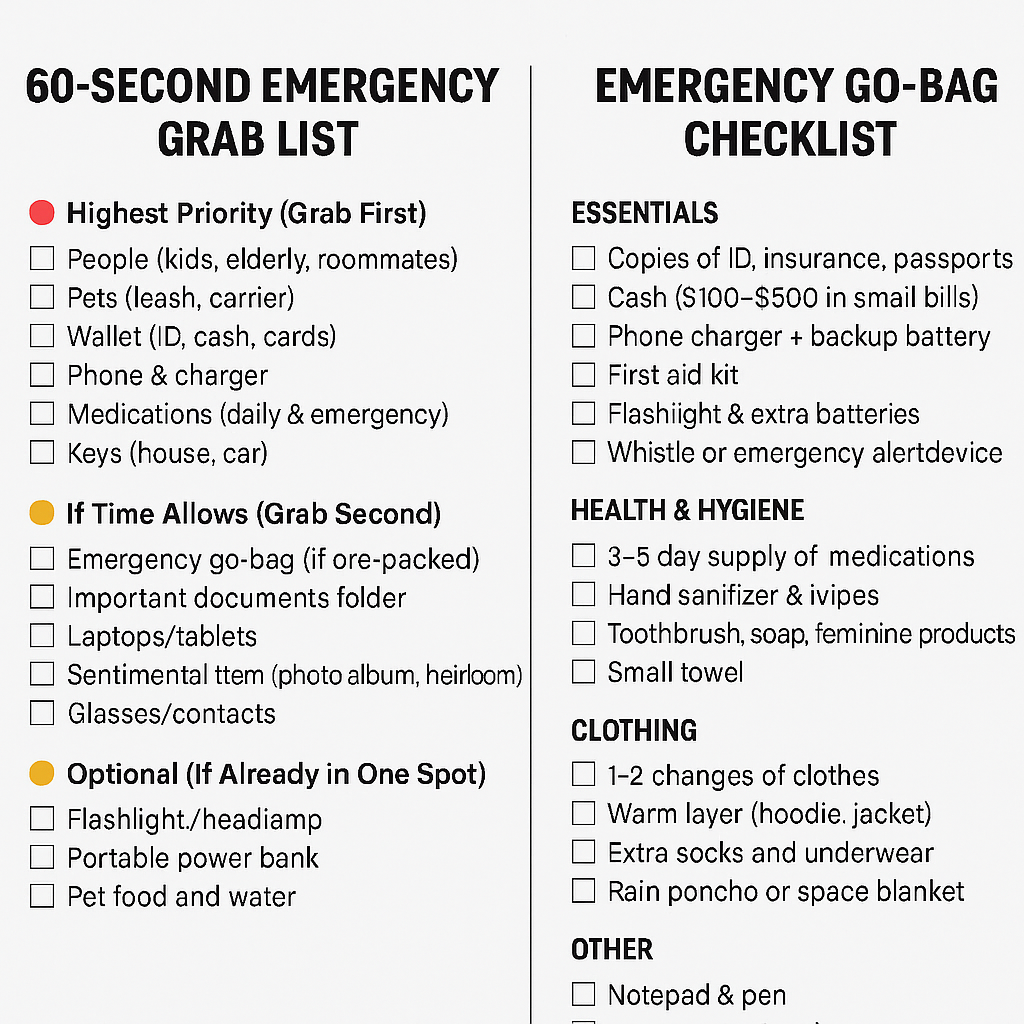
If you only have minutes to evacuate, you need to think fast, stay calm, and grab only the essentials. Here’s a prioritized list of what to take:


🚨 Top Priority: Life-Saving Essentials

  1. People and Pets – Get everyone (including animals) out first.
  2. Keys – Car keys, house keys.
  3. Wallet – ID, credit/debit cards, cash.
  4. Phone & Charger – Communication and navigation.
  5. Medications – Especially life-critical ones like insulin, EpiPens, inhalers.

🎒 Grab-and-Go Emergency Bag (if you’ve prepped one)

  • Copies of documents: passports, insurance, birth certificates
  • Flashlight, batteries
  • First aid kit
  • Water bottles, snacks
  • Change of clothes, socks, underwear
  • Emergency contacts list
  • Small power bank

💻 Digital & Sentimental

  • Laptop or hard drive (if it’s within reach)
  • Important documents (if not already in emergency bag)
  • Jewelry or small irreplaceable heirlooms
  • Photos or sentimental items (if quick to grab)

🐾 If You Have Pets

  • Leash, carrier, food
  • Pet meds
  • Comfort toy or blanket

⏱️ Time-Saving Tip:

If it’s already packed and near the door, take it.
If not, don’t waste time packing—your safety comes first.

It’s not about hoarding. It’s about buying when you can so you’re not desperate when you can’t


There was a day—early in the pandemic—when I stood in a grocery aisle staring at the shelves like they’d personally betrayed me.

Canned goods gone. Rice? Gone. Basic stuff—flour, beans, oats—emptied like someone had cleared out the food pyramid.

I wasn’t panicking. I wasn’t angry.

I just felt… tired. Like someone had pulled the plug on whatever fragile sense of security I’d been clinging to. I had $23 in my checking account, a half gallon of milk at home, and a kid who was asking—again—if we’d still be able to get his favorite cereal.

In that moment, something clicked.

This wasn’t about preppers with bunkers or conspiracy threads on Reddit. This was about everyday life. About the invisible tightrope so many of us walk every day—and how quickly it frays under pressure.


For a long time, I resisted anything that smelled like prepping.

I told myself I didn’t have the budget. I didn’t want to be “that person.” I didn’t want to get caught up in fear-based thinking. And truthfully, part of me thought it meant admitting I wasn’t in control.

But here’s the irony: prepping is what gave me back a sense of control.

Not in the dramatic, “I’m ready for the end of the world” kind of way.

In the quiet, deeply human way of opening a cabinet and knowing I can make something work.


I started small.

A second jar of peanut butter when it was on sale. An extra bag of beans. Gradually learning to rotate things so I wasn’t just stockpiling—I was preparing.

The first time I ran out of money for the week but still had meals I could cook from my pantry, I nearly cried.

Because that feeling? That feeling of knowing I had options?

It was the opposite of desperation. It was peace.


People get it twisted.

They think if you’re buying extras, you’re hoarding. That it’s selfish or paranoid. But prepping, real prepping, isn’t about grabbing everything. It’s about thinking ahead. It’s about pacing yourself, planning around your real life, and slowly building a buffer between you and chaos.

Hoarding is reactive. It’s panic in motion.

Prepping is proactive. It’s self-respect.

It’s also, ironically, how you avoid hoarding. Because when people aren’t desperate, they don’t clean out shelves. When communities have what they need, the system bends instead of breaks.


And I get it—money is tight. For many of us, that’s the whole point.

That’s why prepping on a low income might actually be the most important kind.

You don’t need a survival bunker. You need a week’s worth of meals that don’t rely on paycheck timing. You need to know that if your hours get cut or prices spike, your fridge doesn’t become a source of anxiety.

Even now, when things feel slightly more stable, I still prep.

Not because I expect another wave of disaster—but because life is unpredictable, and I’m finally honest about that.

I prep because I’ve lived the feeling of “not enough” and I never want to feel it again if I can help it.


So no, it’s not about hoarding.

It’s about buying when you can—slow, small, intentional—so you’re not stuck making impossible choices when you can’t.

And that’s not fear.

That’s love in action.

Love for your future self. Love for your family. Love for your sanity.

Because when you don’t have to worry about whether dinner’s covered, you’re free to face the rest of life with a little more strength.

And honestly? In a world that keeps shifting under our feet, that kind of strength is everything.

Unveiling the Pelican Raider Person Fishing Prewired: The Ultimate Fishing Companion

Fishing is more than just a hobby; it’s a way of life for many outdoor enthusiasts. Whether you’re casting your line into a tranquil lake at dawn or navigating the gentle currents of a river, having the right gear can make all the difference. Among the many products designed to enhance your fishing experience, the Pelican Raider Person Fishing Prewired stands out as a versatile and reliable choice. This innovative fishing kayak promises not only to provide an enjoyable ride but also to enhance your fishing capabilities with its thoughtful design and features.

In the world of fishing kayaks, the Pelican Raider Person Fishing Prewired is a game-changer. Designed for both novice and experienced anglers, this kayak combines functionality with user-friendly features that cater to the needs of different types of fishermen. With its prewired system, it allows for easy installation of fishing accessories, making it an ideal choice for those who want to customize their setup. As we delve deeper into the details of this kayak, we’ll explore its construction, features, and overall performance to help you determine if it’s the right fit for your fishing adventures.

Comprehensive Overview of the Pelican Raider Person Fishing Prewired

The Pelican Raider Person Fishing Prewired kayak is crafted with a focus on durability and stability. Made from high-density polyethylene, this kayak is designed to withstand the rigors of various water conditions while resisting UV damage. The robust construction ensures a long lifespan, making it a worthy investment for avid anglers who often find themselves navigating through rocky rivers or rough lakes. The kayak’s stability is further enhanced by its wide hull design, allowing for a secure and steady ride, even when casting lines or reeling in fish.

One of the standout features of the Pelican Raider kayak is its prewired system. This innovative aspect allows anglers to easily install various fishing accessories, such as fish finders, rod holders, and lights, without the hassle of complicated wiring. The kayak comes equipped with built-in wiring that simplifies the process, enabling users to set up their fishing gear quickly and efficiently. This feature is especially beneficial for those who frequently change their fishing configurations or gear, as it eliminates the need for time-consuming installations each time you hit the water.

Comfort is another crucial factor when choosing a fishing kayak, and the Pelican Raider does not disappoint. The kayak is designed with an adjustable backrest and padded seat, providing maximum comfort during long hours spent on the water. The seating arrangement allows for easy movement, enabling anglers to cast lines or retrieve gear without feeling restricted. Additionally, the kayak features multiple footrest positions, accommodating users of different heights and ensuring a comfortable paddling experience.

Storage is an essential consideration for any fishing trip, and the Pelican Raider excels in this aspect as well. The kayak is equipped with ample storage space, including a large rear tank well and additional compartments for storing tackle boxes, coolers, or personal items. The secure storage options allow anglers to keep their gear organized and easily accessible, minimizing distractions while focusing on the fishing experience. The kayak also features bungee cords on the front and rear, providing additional securing options for larger items.

Performance-wise, the Pelican Raider Person Fishing Prewired is engineered to offer a smooth and efficient ride. Its lightweight design makes it easy to maneuver, while the hull shape promotes excellent tracking and speed. Whether you’re gliding across calm waters or paddling against a current, this kayak provides a responsive and enjoyable experience. Its performance is complemented by the kayak’s stability, which instills confidence in users when standing or casting from the deck.

Lastly, the Pelican Raider kayak is equipped with safety features that enhance its usability. The kayak includes built-in handles for easy transport and carrying, ensuring that you can easily launch or retrieve it from the water. Additionally, the kayak is designed with a self-bailing feature, allowing any water that enters the cockpit to drain out quickly. This feature is particularly important for maintaining stability and comfort during your fishing excursions.

Tips and Advice for Maximizing Your Fishing Experience

To get the most out of your Pelican Raider Person Fishing Prewired kayak, consider investing in quality fishing accessories that complement its features. A good fish finder can significantly enhance your ability to locate fish, while sturdy rod holders will keep your gear secure while you paddle. Furthermore, consider using a dry bag to store your personal items and electronics to protect them from water damage.

It’s also beneficial to familiarize yourself with the kayak’s handling and performance in different water conditions before embarking on a fishing trip. Take some time to practice paddling in calm waters to understand how the kayak responds to your movements. This practice will build your confidence and enable you to navigate more challenging conditions with ease.

Pros and Cons of the Pelican Raider Person Fishing Prewired

Pros:

  1. Durable Construction: Made from high-density polyethylene, the kayak is built to last and withstand various environmental conditions.
  2. Prewired System: The easy installation of accessories allows for customization without the hassle of complex wiring.
  3. Comfortable Seating: The adjustable backrest and padded seat ensure comfort during long fishing trips.
  4. Ample Storage: With multiple storage compartments and bungee cords, the kayak provides sufficient space for all your fishing gear.
  5. Stable Performance: The wide hull design offers excellent stability, making it suitable for both beginners and experienced anglers.

Cons:

  1. Weight: While lightweight for a fishing kayak, it may still be challenging for solo users to transport without assistance.
  2. Limited Speed: The kayak prioritizes stability over speed, which may not appeal to those looking for a faster ride.
  3. Accessory Limitations: While the prewired system is a great feature, it may limit options for certain high-tech accessories that require more complex installations.

Common FAQs About the Pelican Raider Person Fishing Prewired

1. Is the Pelican Raider suitable for beginners?

Yes, the Pelican Raider Person Fishing Prewired is an excellent choice for beginners due to its stability, user-friendly features, and comfortable design. New anglers will find it easy to maneuver and fish from.

2. How much weight can the kayak carry?

The Pelican Raider is designed to carry a maximum weight capacity of approximately 400 pounds. This capacity makes it suitable for one or two anglers, along with their gear.

3. Can I use this kayak in saltwater?

While the Pelican Raider is primarily designed for freshwater fishing, it can be used in saltwater environments. However, it’s essential to rinse the kayak thoroughly after each use in saltwater to prevent corrosion and damage.

Conclusion

In summary, the Pelican Raider Person Fishing Prewired is a remarkable fishing kayak that caters to the needs of both novice and experienced anglers. Its durable construction, comfortable seating, ample storage, and innovative prewired system make it an attractive option for anyone looking to enhance their fishing experience. The kayak’s stability and performance ensure that users can navigate various water conditions with confidence, making it a reliable companion for fishing adventures.

Overall, if you’re in the market for a fishing kayak that combines functionality, comfort, and durability, the Pelican Raider Person Fishing Prewired is worth considering. With its thoughtful design and user-friendly features, this kayak promises to elevate your fishing excursions to new heights, allowing you to focus on what truly matters: the thrill of the catch and the joy of being on the water.

Dependence on Failing Systems

We live in a world of fragile systems—systems that can crumble in an instant. The power grid, food supply chains, clean water access—most people never stop to think how thin the line between normalcy and chaos truly is. But deep down, you know the truth. If these systems failed tomorrow, how would you protect your family?

Here’s the reality: depending on unreliable systems is a risk most aren’t prepared for. When things are running smoothly, it’s easy to trust that everything will stay that way. But what happens when the unexpected strikes—a blackout, a supply shortage, or a financial crisis? When others panic, scrambling to find solutions, you have the opportunity to stay calm and prepared. Why? Because you’ve already taken control of your future.

Picture this: no matter what disruption arises, you remain confident. You have a sustainable plan in place—food stored, water purified, and backup power ready. You’re not a victim of the system; you’ve created your own security. While others stand in line for dwindling supplies, you’re miles ahead. That’s what true independence looks like.

And the best part? It’s not as difficult as you might think. Prepping doesn’t require extreme measures. It’s about making smart, practical decisions today that set you up for success tomorrow. By taking small steps now, you can achieve a level of self-sufficiency that ensures your family will never be caught off guard.

Don’t leave your future in the hands of failing systems. You have the power to break free from that dependence—and when you do, you’ll feel unstoppable. Imagine the relief of knowing you’re ready for anything life throws your way. It’s a freedom most can only dream of, but it’s within your reach right now.

Are you ready to make that dream your reality? The time to act is today. Your future self will thank you.