It’s not the sound of a siren that wakes you. It’s the silence. The hollow hum of a dead refrigerator. The eerie quiet where the power grid’s heartbeat used to be. Your phone is a dark, useless slab. In that moment, the carefully stocked bin in your closet feels a million miles away. Because a kit, on its own, is just a pile of things. What you truly need isn’t a what. It’s a how. You need the invisible infrastructure—the silent, pre-installed operating system that boots up the second the world flickers. This isn’t about prepping. This is about building your family’s protocol for chaos.
When the Lights Go Out: Your Plan is a Ghost
We’ve all told ourselves, “We have a plan.” But under the crushing weight of a real crisis, those paper-thin plans dissolve. Fear does that. It narrows your vision, turns your hands cold, and shuts down the logical part of your brain. What you’ve written down? Forgotten. The vague “we’ll figure it out” promise? Useless. What you need isn’t a plan. It’s a protocol. A set of actions so deeply practiced, they feel like muscle memory.
The Four Layers of Staying Alive
Think of your readiness not as a checklist, but as a stack of layers, each one supporting the next.
- The Mind: This is your foundation. It’s the calm in the storm. The grit to make a hard decision when every cell in your body is screaming to panic. Without a resilient mind, the fanciest gear is just dead weight.
- The Material: This is your disaster preparedness kit for home and car. The water, the food, the first-aid supplies. It’s the tangible proof you saw this coming. But on its own, it’s inert. It’s potential energy waiting for a spark.
- The Method: This is the spark. It’s the how. How do you purify water if the filter fails? How do you secure a broken window? Method is what turns your stuff into capability. It’s the playbook for the game you never wanted to play.
- The Communication: This is the lifeline. It’s the family communication tree, the rally points, the silent language of hand signals. This layer transforms a group of individuals into a coordinated team, moving with a single purpose.
The Software You Forgot to Install
Anyone can buy a 72-hour survival kit. It’s the easiest part. The software—the drills, the agreements, the practiced rhythms—is what most people never download. This software includes the unspoken rules: the decision trees that tell you if this, then that; the skill memory of knowing how to shut off the gas valve blindfolded; the social scripts for dealing with a frightened neighbor or an anxious authority figure.
Your Home Isn’t a Shelter. It’s a Command Node.
In a crisis, your house must transform from a place of comfort into a headquarters. Your home emergency kit isn’t a stash. It’s the beating heart of your central command node.
Where Do We Go? The Rally Point & The Communication Tree
“Meet at home” is a great idea until the roads are closed or the house is compromised. You need a cascade of options.
- Primary Rally Point: Inside the home. A fortified interior room, like a bathroom during a tornado.
- Secondary Rally Point: Outside the home. The big tree in the backyard, the garden shed.
- Tertiary Rally Point: A neighborhood location. The library, the community center.
Your family communication tree is a pre-assigned phone chain. Person A calls B and C. B calls D and E. This isn’t a suggestion; it’s a protocol. It prevents everyone from calling the same person and crashing the network.
The Shift Schedule: The Antidote to Exhaustion
Your 72 hour emergency backpack has 72 hours of supplies. That doesn’t mean you can operate for 72 hours straight. Fatigue makes cowards and casualties of us all.
- Create a Roster: 4-hour shifts for watch, rest, and maintenance.
- Define Roles: Who is on water duty? Who handles communications? Who is the medic?
- Schedule Rest: This is non-negotiable. Mandatory rest is what prevents the single mistake that unravels everything.
Do You Know Where Your Water Shut-Off Is?
It’s a simple question. But in the dark, with the sound of water rushing, would you know? This is where protocol becomes action.
- Map Your Home: Take pictures. Label them. “MAIN WATER SHUT-OFF.” “GAS MAIN VALVE.” “ELECTRICAL PANEL.”
- Create Laminated Cards: Simple, illustrated steps for each critical task. Keep them with your home survival kit. Make it idiot-proof, because in a crisis, we’re all idiots.
Your Car Kit: The Reconnaissance Unit
Your car emergency kit is not a smaller version of your home supplies. It has a different, more urgent mission: to become a mobile lifeline, a deployed reconnaissance unit dedicated to getting everyone back to the command node.
The Get-Home Agreement: The Rules of Engagement
This is the family contract, signed in calm times, for use in chaotic ones. It eliminates the “what do I do?” paralysis.
- Rule 1: If an event happens within your 5-mile “bubble” during the day, you move. Now.
- Rule 2: If a shelter-in-place order is given for your current location, you secure your position and signal your status.
- Rule 3: A car is a tool, not a safe room. If the roads are dead, you abandon it for a pre-planned route on foot.
Your Car is a Power Plant on Wheels
That metal box in your driveway is a giant battery and a potential signal tower.
- Power Inverter: Plug this into your car survival kit. It turns your cigarette lighter into a charging station for phones, radios, and medical devices.
- Signal Booster: A small, often-overlooked device that can grab one more bar of cell signal—the bar that lets a crucial text message get through.
- The Humble Radio: An AM/FM radio with a long antenna can pull in emergency broadcasts long after your smartphone becomes a brick.
The Currency of Kindness: Barter & Goodwill
In a collapse, the most valuable asset isn’t in your bank account. It’s in your community. Trust is the new gold.
- Barter Inventory: A small, separate pouch in your kit. Extra water filters, high-calorie bars, duplicate medical supplies. Not for hoarding. For trading.
- Goodwill Tools: A dedicated first-aid kit for helping others. A multi-tool to lend. These small acts build social capital—the kind that might buy you safe passage or a critical warning.
The Quarterly Drill: Where Fantasy Meets Reality
A plan you don’t practice is a fantasy. You have to pressure-test your systems. You have to fail in safety to succeed in chaos.
The 15-Minute ‘Power’s Out’ Drill
Pick a random Saturday. Announce: “Drill start. Power is down. Cells are dead. You have 15 minutes.”
- The Mission: Can everyone find the rally point without speaking? Can your teenager locate the water valve? Can you retrieve and inventory the emergency backpack in the dark?
- Introduce Chaos: “The primary rally point is blocked by simulated smoke.” Now what? How does the protocol adapt?
The After-Action Review: The Most Important 10 Minutes
The drill isn’t over when the timer beeps. It’s over after the debrief. Gather everyone and ask:
- What was supposed to happen?
- What actually happened?
- What do we need to change for next time?
This loop of practice and refinement is what turns a family into a team.
The Hardware for Your Operating System
All this talk of protocols and systems needs a physical anchor. It needs reliable, intuitive hardware. This is where a purpose-built kit stops being a “product” and becomes the enabling core of your invisible infrastructure.
How the Right Kit Feels Like an Extension of Your Will
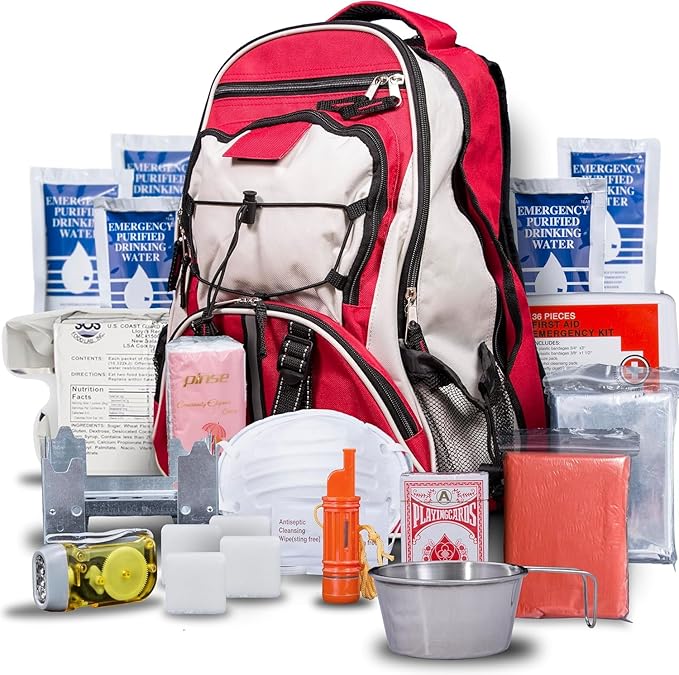
We built this methodology using the Blue Seventy-Two Pro Series Red Deluxe 72-Hour Emergency Backpack as our benchmark. Here’s why it fits the OS model:
- It Offloads Thinking: The kit is logically organized. You don’t waste precious mental energy searching for a light source; it’s in the intuitively labeled pocket. In a crisis, cognitive clarity is everything.
- It Builds in Backup: Multiple fire starters. Multiple water purification methods. This redundancy is the material expression of a robust protocol. It ensures a single point of failure doesn’t break your entire system.
- It’s a Complete Baseline: With its comprehensive range of items, it solidifies the Material Layer, giving you the confidence to focus your energy on the higher, more critical layers of Method and Communication.
Weaving the Kit Into Your Family’s Story
This is where it all comes together. During our *15-minute ‘Power’s Out’ drill*, the Blue Seventy-Two isn’t just a prop; it’s a character.
- Drill Objective: Establish Comms. A child is tasked with retrieving the hand-crank radio from the kit’s main compartment.
- Drill Objective: Triage Injury. The comprehensive first aid module is deployed, and its contents become familiar, not foreign.
- Drill Objective: Secure Water. The water purification tablets are located, assigned, and become part of a practiced routine.
By integrating a specific, well-designed disaster preparedness kit for home and car into your drills, you move from abstract theory to lived experience. The kit becomes an old friend. Its contents become extensions of your own hands.
Products / Tools / Resources
This isn’t a checklist; it’s a curation of tools that have earned their place in the system we’ve described.
- The Foundation Kit: The Blue Seventy-Two Pro Series Red Deluxe. We use it as our core home base kit because of its logical organization and built-in redundancies, which are critical for executing protocols under stress.
- Communication Lifeline: A hand-crank NOAA weather radio with a USB charging port. It’s your link to the outside world when everything else fails.
- Power When It’s Gone: A reliable 300-watt power inverter for your car. This turns your vehicle into a true emergency power station.
- The Knowledge Archive: A physical, printed manual of basic survival skills and a laminated copy of your home’s system maps (water, gas). Don’t rely on a digital file.
- The Get-Home Bag: A lightweight, durable backpack stocked with a core set of supplies from your main kit—water, a filter, high-calorie food, a first-aid kit, and a power bank—designed to live in your car trunk.